
To register, go here.

A cyanobacteria bloom has been observed at your lake, please see below for details.
| Waterbody | Pawtuckaway, Nottingham |
| Status | REPORT |
| Issued | 5/28/2025 |
| Bloom Description (photos attached) | Green surface accumulations along the shoreline |
| Cyanobacteria Taxa | Dolichospermum |
| Cyanobacteria Density (cells/mL) | Near Dolloff Dam: Too Numerous to Count (TNTC)
Beach Road Beach: 470,000 |
| Notes | Bloom conditions were first observed on
5/27 near the Dolloff Dam. Samples collected on 5/28 exceeded the recreational threshold at both Dolloff Dam and Beach Road Beach.
Please report through the Bloom Report Form if you continue to see bloom conditions. |
Please visit the Healthy Swimming Mapper for the most current information about bloom location, status, and severity .
Cyanobacteria reports depict only what an observer sees in the water. The report may reflect a waterbody wide perspective if they boated around the waterbody and made observations, or it could be a single sighting from the shoreline. One sighting does not indicate that a watch or warning is necessary, but it does indicate that those on or around the waterbody should be aware that cyanobacteria have been observed beyond what is natural, and that they should be on the lookout for shifting bloom conditions and report them via the Bloom Report Form.
Watches are issued when samples are evaluated and cyanobacteria are in higher abundance than normal background levels at multiple locations, but that densities are below 70,000 cells/mL or when clear photographic evidence indicates a bloom is occurring.
Warnings are issued when samples are evaluated microscopically, and cell counts exceed 70,000 cells/mL and the bloom is widespread or extends to multiple locations on the waterbody. A warning does not close the waterbody to recreational use. The warning is intended as a precautionary measure to inform the public of the potential health risks associated with cyanobacteria blooms. Please see our newly updated FAQs for more information.
NHDES advises lake users to not swim in or near the vicinity of where bloom material is visible. Please also keep pets and livestock out of areas where bloom material is observed. It is suggested that local authorities post the 2025 cyanobacteria sign at public access points while a warning is in place to alert the public of current conditions.
| Corey Clark, P.E., Chief Engineer at the Dam Bureau, NH DES, has this update on the situation at Dolloff Dam:
“The good news is that Pawtuckaway Lake is now full. The sinkhole at Dolloff Dam has not increased in size since it was first observed this spring and leakage through the dam has stabilized at the full lake elevation. However, we are still physically monitoring the site twice a week and several sensors are still providing real time data on the rate of leakage and the water level in several monitoring wells. We are still concerned that sediment is being transported with the leakage resulting in the continued loss of embankment material from the dam. While the volume of sediment is very low, it still needs to be monitored for changes or increases and ultimately needs to be remediated. Diving is scheduled to take place at the dam next week and we are currently working with our engineering consultant to schedule additional test borings at the dam. It is likely that these borings will take place later this summer and will allow us to better understand why the sink hole has developed and what can be done to remedy the situation. It is likely that any remedy will be temporary, and a much larger future rehabilitation of the dam will need to occur to mitigate this and other dam safety issues. Additionally, the removal of Burnhams Marsh Dike has been completed and the site of the former dam has now been restored to what we believe was the condition of the site prior to the installation of the dam. While I hope you find this email as good news, if we observe that the sinkhole is increasing in size or if the structural stability of the dam is questioned, then we will again start lowering the elevation of Pawtuckaway Lake to reduce the risk of an emergency situation from developing. Should that need arise I will notify everyone on this email as soon as possible. I will discuss the status of things when I speak at the Annual Pawtuckaway Lake Improvement Association Meeting on June 14th at 9:30am at the Pawtuckaway State Park Pavilion. Hope to see you there.” |
Corey Clark, Chief Engineer at the NH DES Dam Bureau, has this update on Pawtuckaway Lake levels:
Unfortunately, the Burnhams Dike removal project will not be wrapped up until Thursday of this week. Until that time we will need to maintain Pawtuckaway Lake 1-2 feet lower than normal in order for the work to occur and will be discharging out of Drowns to keep the level down. As soon as we wrap up the removal project later this week, we will shut down flow from Dolloff and Drowns to store any runoff into the lake.
Read the current and past issues of PawPrints here. The oldest issue that is currently available is from 1992 although there is a big gap from 1992 to 2005 that would be nice to fill. If anyone has issues that are not currently on the website we would love to add them! Just send an email to Info@PawtuckawayLake.com or contact Pam Kelly or Neil Santos.
This report comes from NH DES, where the Dam Bureau has been busy working on dams and dikes in Pawtuckaway:
The removal of Burnham’s Dike is serving an important role in helping to keep the organic matter present in Burnhams Marsh from washing into Fundy Cove, were the dam/dike to have failed. This effort will help protect water quality within Fundy Cove and, therefore, the rest of Pawtuckaway Lake.*
While the low lake level at present is an inconvenience to anglers who wish to cast their lines in the shallow areas of the lake, the delay in raising the lake to normal summer level should ultimately be of long-term environmental benefit for all stakeholders.
Removal at the Burnhams Marsh Dike/Dam is proceeding smoothly. The removal effort is anticipated to finish up by the end of this week. That same crew has some work to perform on a couple of other dams within the State Park next week, but they should be out of there after that.
At Drowns Dam, the gate is open a few inches to allow the required minimum flow for the stream, but the lake level is still 1.5-2 ft below the spillway elevation associated with normal summer lake level.
At Dolloff, the lake is holding steady at the level of the stop logs and spilling over to provide the minimum required discharge as well. Once the crew has finished with their work within the State Park next week, the plan is to continue bringing the lake up to normal summer level. This will involve adding more stop logs at Dolloff. NHDES continues to monitor the Dolloff Dam and the sinkhole on the crest to ensure the dam remains safe as the water levels rise. As Corey Clark previously shared, if conditions at Dolloff Dam change in such a way as to generate concern, then it may prove necessary to lower the lake level back down to reduce the loading on the dam.
* And moving water out through Drowns Dam is another way to get rid of the nutrient-rich effluent leaving Burnhams Marsh – Ed.
Corey Clark, Chief Engineer of the Dam Bureau, NH DES, has this report:
We have an update on the situation at Dolloff Dam. Since my last message we have completed the following tasks:
As for my last bullet, those of you on Pawtuckaway Lake have likely observed the level of the lake increase over the past few days. While we still don’t have all the answers regarding why the sinkhole developed or if the sinkhole should just be monitored or repaired, we are cautiously trying to capture the recent rain events to fill the lake. As you can see in the graph below, we are now just above the elevation in which we first observed the sinkhole and started lowering the lake. We are continuing to visit the site regularly to see if any changes are observed as we increase the water elevation. However, if we observe that the sinkhole is increasing in size or if the structural stability of the dam is questioned then we will again start lowering the elevation of Pawtuckaway Lake to reduce the risk of an emergency situation from developing.
Moving forward the Dam Bureau will be performing the following:
As previously stated, the last bullet is contingent on making sure that the dam is performing as expected and there is no increased threat to downstream individuals. In the attached plot you can see that we still have 3.5 feet of pond increase until we reach the summer elevation.
Additionally, we ask that you and members of the public refrain from exploring the dam by foot or by water. We are more than happy to answer any questions, but we want to make sure that nobody gets injured while exploring the site.
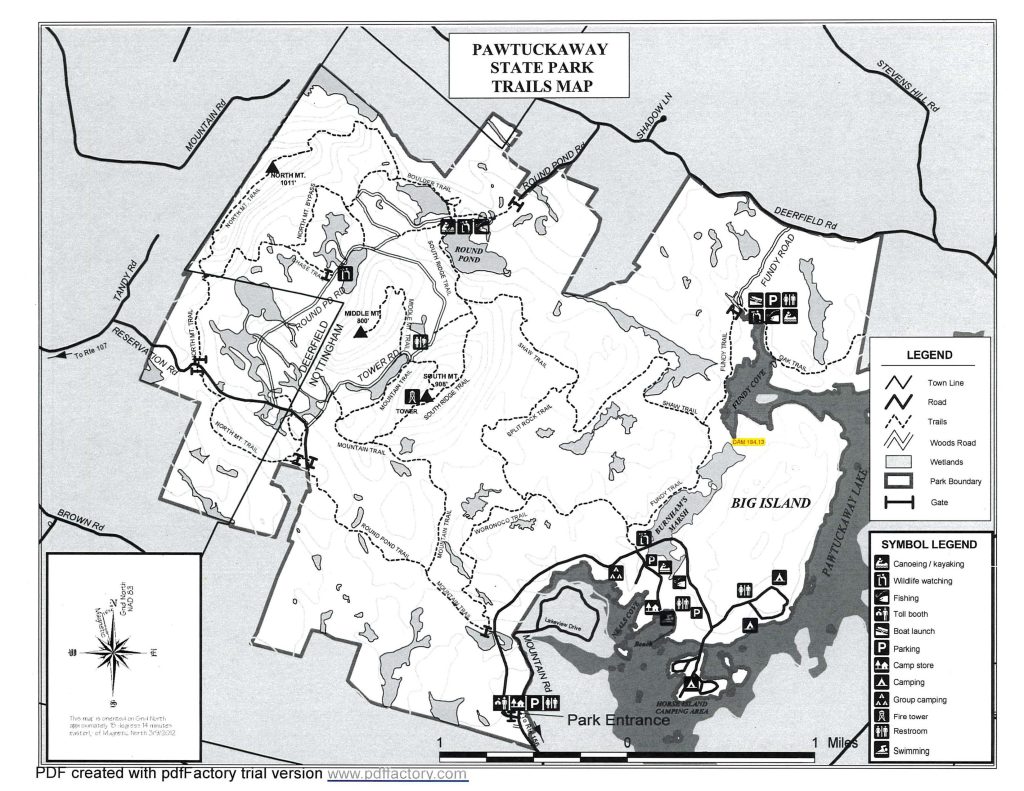
Corey Clark, Chief Engineer of the Dam Bureau, NH DES, has a new report, this time about Burnham’s Marsh in the State Park:
I would like to make you aware that last week the Dam Bureau received a phone call from Pawtuckaway State Park about the conditions and concerns surrounding the level of the water at Burnhams Marsh within the State Park. (See map above, to the left of Big Island.)
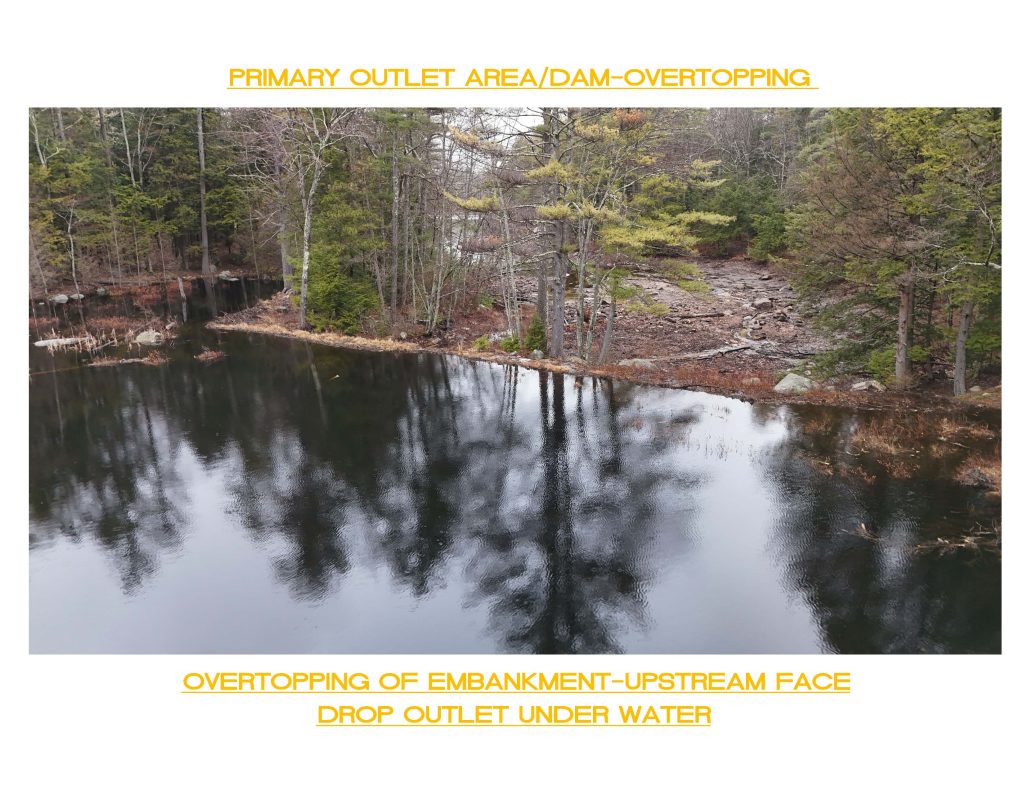
The Dam Bureau visited the site and observed that the dike (it’s actually a dam, not a dike) at the north end of Burnhams Marsh was overtopping and in a state of failure due to the presence of a beaver dam constructed on top of the dam. Even though Burnhams Dike (NHDES dam number D184013) is within Pawtuckaway State Park (in yellow on the map above), it is owned by NH Fish and Game, so the responsibility for maintaining and repairing the dam lies with the NHDES Dam Bureau. On Friday of last week, I too visited the site to evaluate the condition of the dam and determine what could be done to alleviate the current threat to the main road in Pawtuckaway State Park.
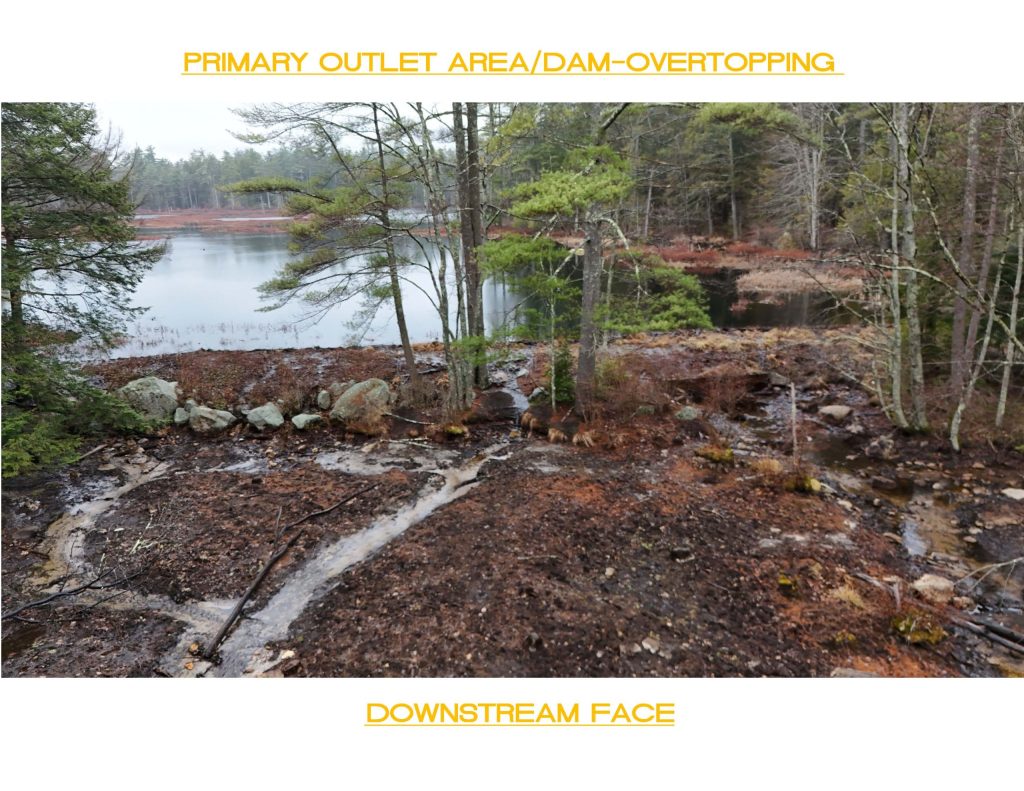
After visiting the site and discussing the situation internally, the Dam Bureau has applied for and received Emergency Authorization through the NHDES Wetlands Bureau to remove Burnhams Dike. Due to the ongoing overtopping of the dike, it can no longer function safely and is at threat of failure. The embankment is severely eroded and without major repairs will continue to be structurally unstable. Additionally, the corrugated metal outlet pipe in the outlet works at the base of the dike is also on the verge of collapse and can no longer safely discharge water. If the dike were to fail, debris and sediment would inundate Pawtuckaway Lake near the Fundy Cove boat ramp/channel immediately downstream of Burnhams Dike.
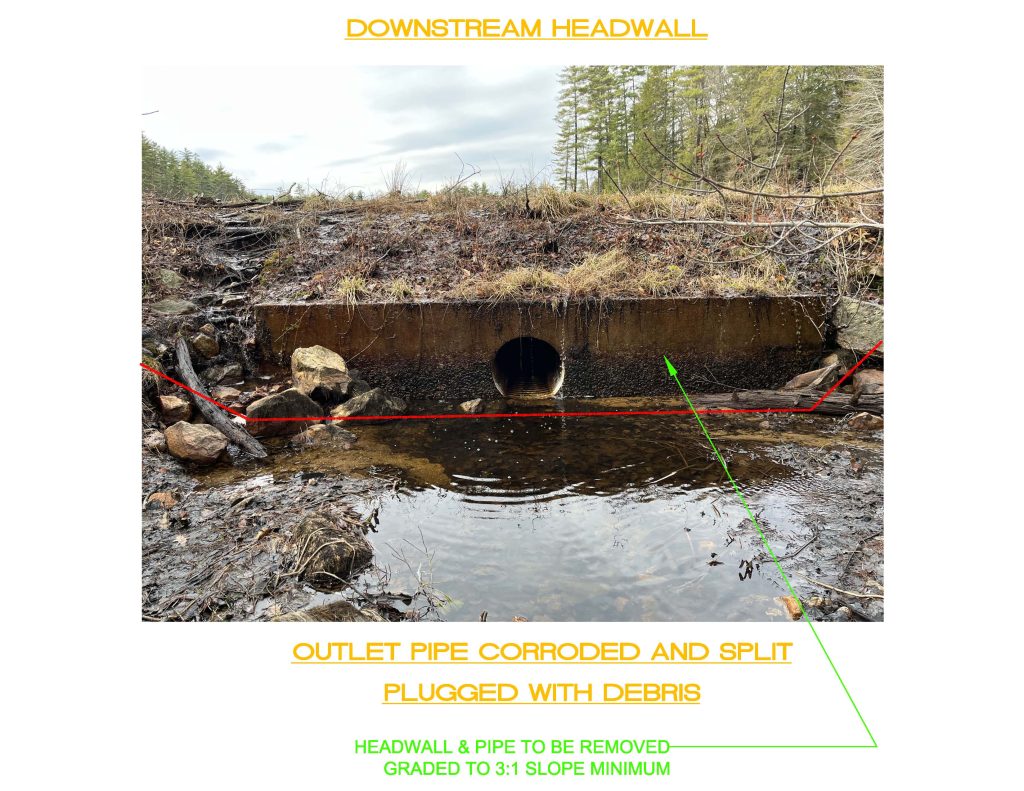
While the removal of the dike will impact the water level of Burnhams Marsh and alleviate the current water inundating the main access road through Pawtuckaway State Park’s, it will also allow for the marsh to return to the natural configuration before the dike was constructed. The Dam Bureau will remove as much of the dike as possible so that any remaining portions of the manmade structure will no longer have the ability to impound water to a magnitude that could threaten infrastructure or Pawtuckaway Lake and is no longer a jurisdictional dam.
The Dam Bureau intends on starting this work during next week and completing the work during the week of April 21st -25th. This tight timeframe is necessary to alleviate the current situation, but also the work can be completed while Pawtuckaway Lake is lower than normal for this time of year.
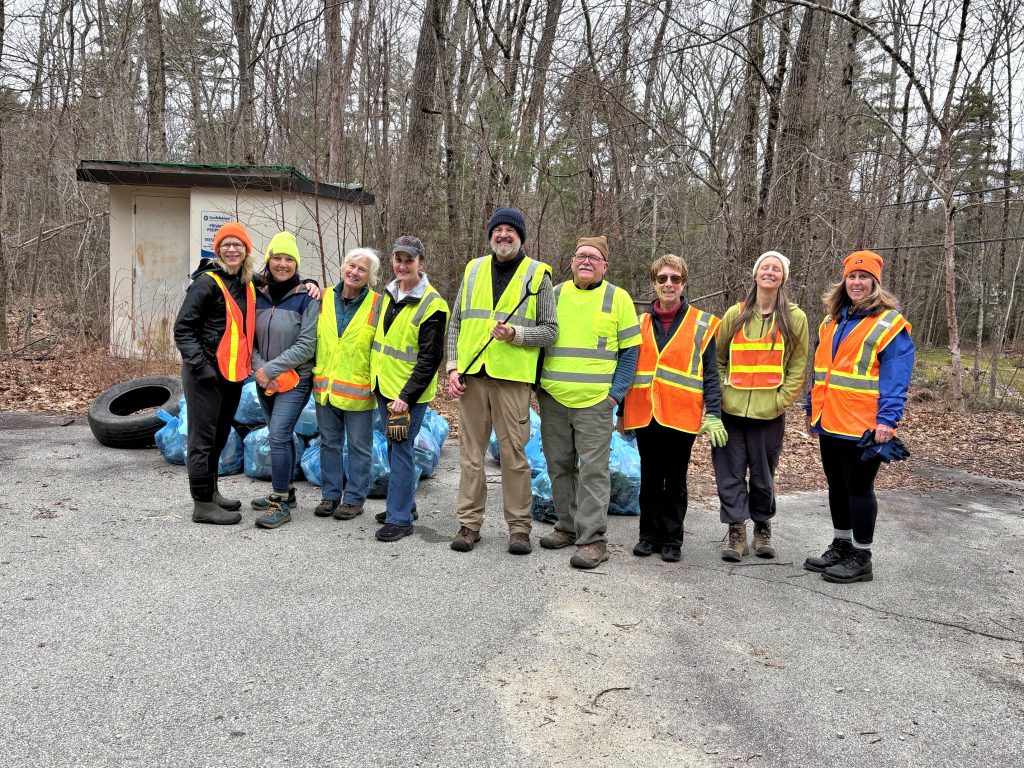
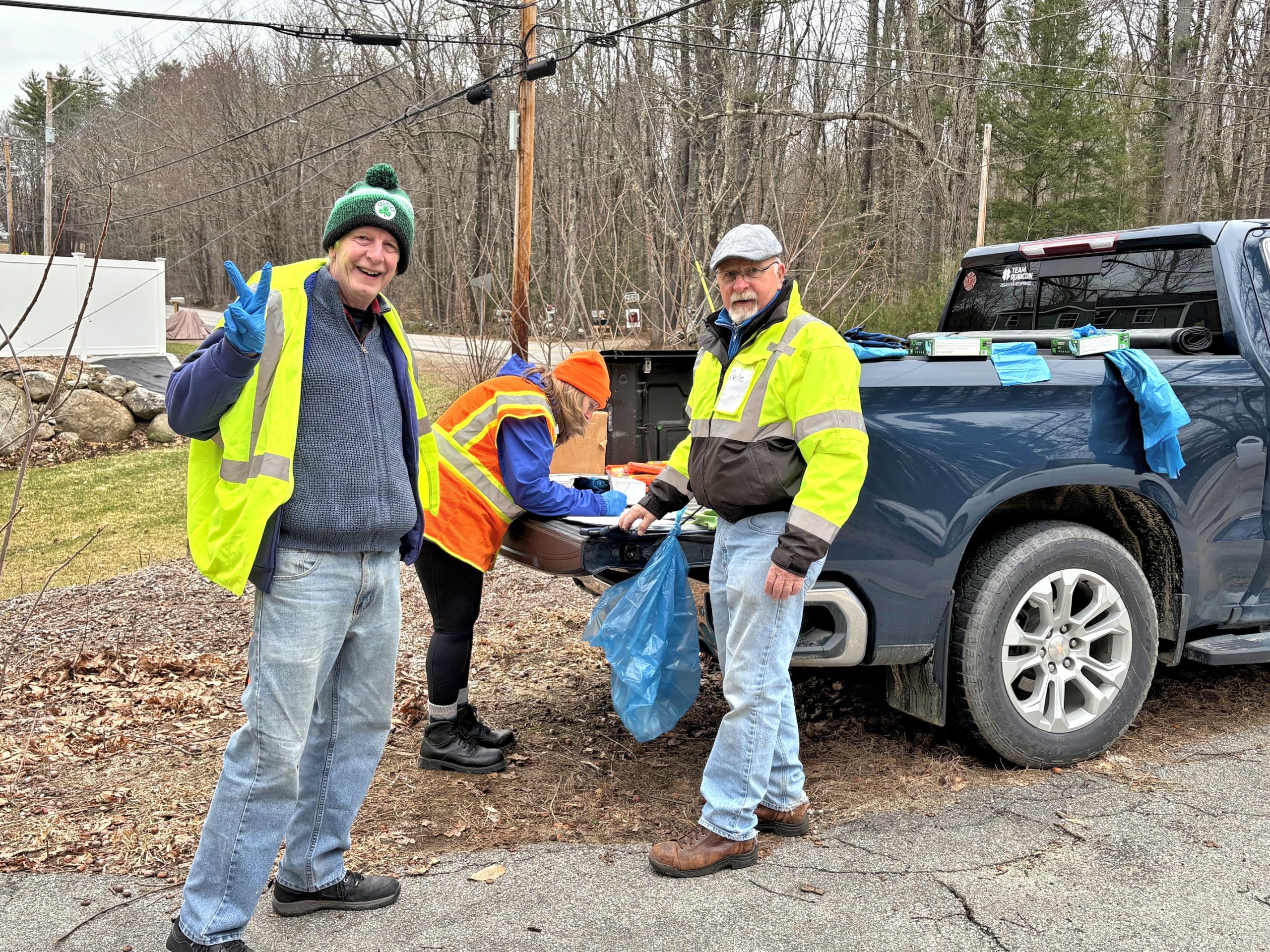
A crew of volunteers for the PLIA did more than just talk trash – they removed it from a stretch of highway along Route 156 on Saturday morning, April 5. Our local police department provided an assist by sending out two notices advising motorists to be on the alert for these volunteers and to drive with caution.
As these photos illustrate, workers showed up in force with great can-do attitudes, and in no time they had cleared many bags of litter thrown onto the roadside over the winter. Just look at their haul!

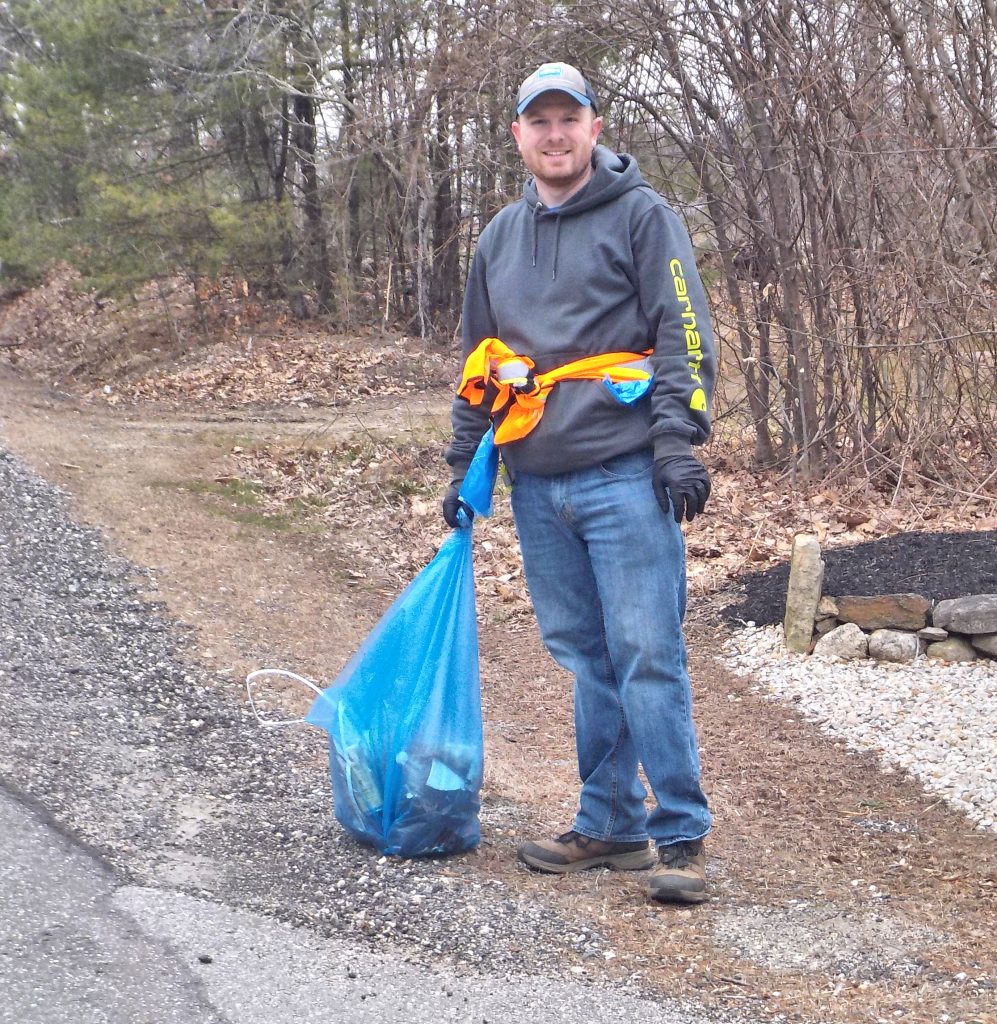


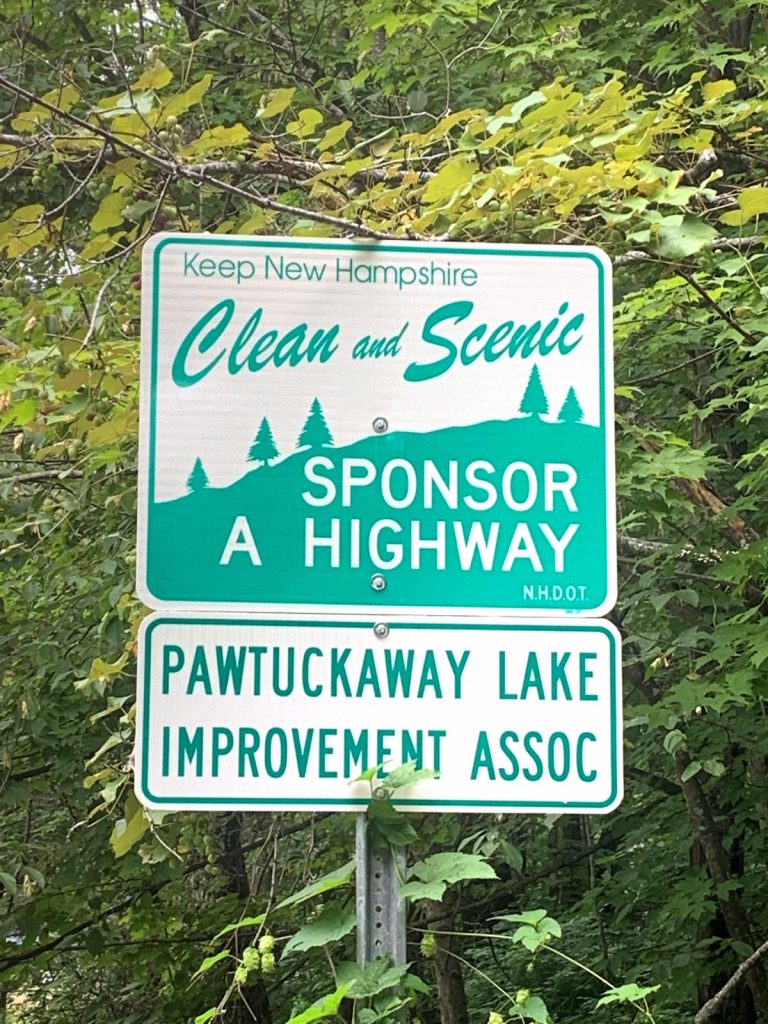
The PLIA organizes three such events every year, so if you missed this one, there will be another this summer – look for announcements. Removing trash from the environment prevents motor oil, battery fluid, tires, and other pollutants from entering our watershed. We love our town and want to keep it “Clean and Scenic”!
PLIA President Tom Duffy recently spoke with Corey Clark, Chief Engineer of the Dam Bureau, NH DES. Here is what he learned about Dollof Dam and its repairs:
Dolloff Dam has been under study from 2020, when leakage under and through the dam was discovered. Monitor “test” wells were installed to determine the cause and amount of the leakage more accurately. When water was raised to “full pond”, wells showed higher leakage. When the lake was lowered, test wells showed less leakage, demonstrating that water has been seeping through the dam. The dam bureau also noted gaps in the large blocks on the water side of the dam. The immediate plan is to lower the lake down the full 7 feet that is possible at the dam. This will expose gaps in the blocks on the lake side of the dam to allow them to be patched with concrete.
It is estimated that ALL THIS WORK SHOULD BE COMPLETED BY the end of the first week of April if they are able to start work by April 1. This is contingent on getting the lake sufficiently lowered by that time.
Boards will then be put back into the dam and the test wells will be monitored as the lake refills. Based on the data from the test wells, the dam bureau will determine if the leakage has been decreased and if the sink hole is growing or is stabilized.
At some point this spring, divers will check the bottom of the dam from the lake side for additional gaps and suspicious areas.
A second monitoring station is measuring the leakage from the bottom of the dam where there is a sealed door acting as a plug at the very bottom of the dam. There are monitoring “weirs” there and data is collected hourly to determine the amount of leakage from this area and to see if the leakage increases as the lake fills.
In addition to this immediate work on Dolloff Dam, be aware that 4 locations on Pawtuckaway are under review by the NH DES for more extensive renovation. Those locations are the two dams on the lake, Dolloff and Drowns, and the two dikes, Gove Dike and Drowns Dike. At some, as yet undetermined time in the future, the dams and dikes may be subject to major repair and large, perhaps total, drawdown of the lake may be necessary.